From Sanctions to Siege: Venezuela and the Old American Playbook
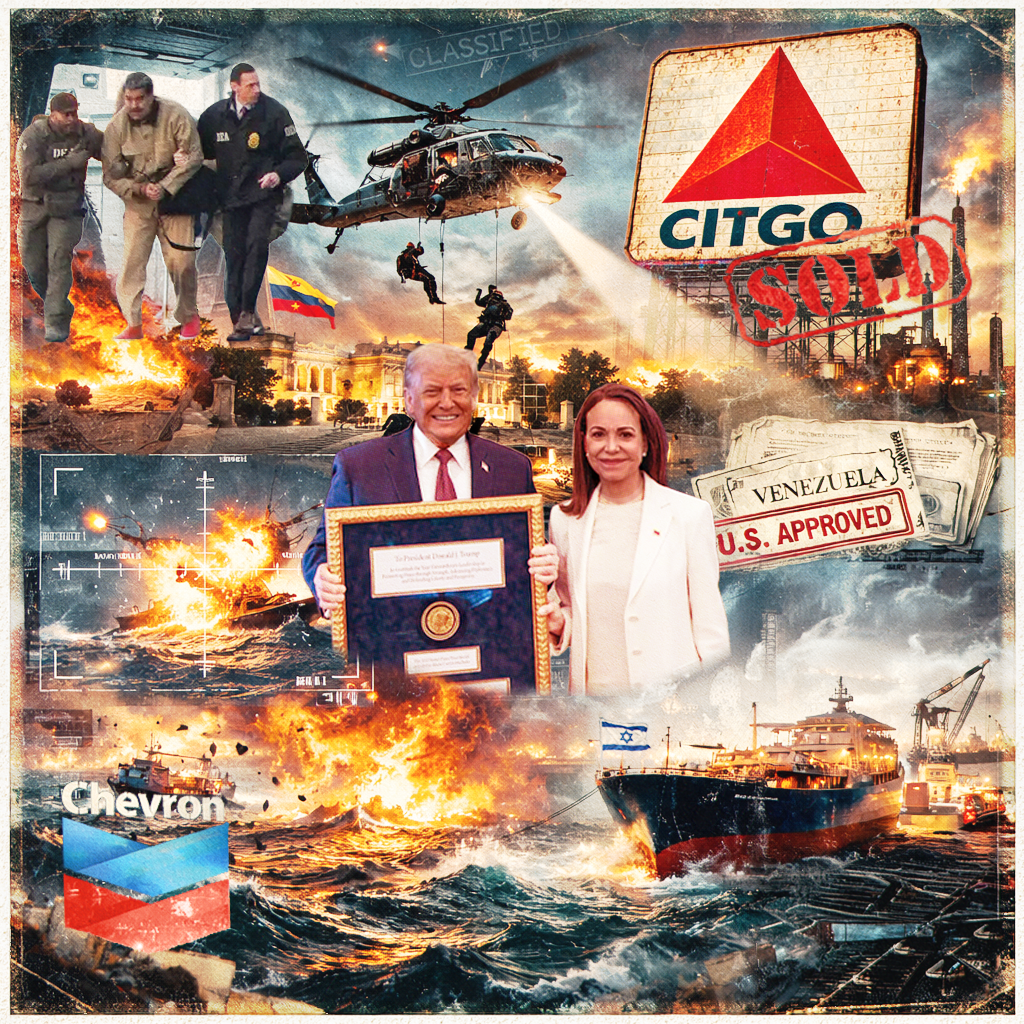
The US abducts Maduro, bombs Caracas, blocks tankers, and redirects Venezuelan oil to allies—a display of 21st-century imperialism disguised as law enforcement
In the second week of February 2026, a tanker operated by Israel's Bazan Group loaded Venezuelan crude oil and set course for a Haifa refinery. It was the first such shipment in 17 years.
The last time Venezuelan oil reached Israel was in 2009, before President Hugo Chavez severed diplomatic and commercial ties in response to Israel's Operation Cast Lead in Gaza.
His successor, Nicolás Maduro, maintained that stance, refusing to normalize relations with a government he accused of engaging in a “war of extermination” against Palestinians.
Today, Maduro is no longer in a position to object. He is sitting in a federal prison facility in New York City, awaiting trial on narcoterrorism charges after U.S. special forces bombed his capital, breached his residence, and flew him out of the country in a mid-night raid.
Indeed, the man who’d blocked oil trade with Israel has been removed through extraordinary rendition, and his nation’s oil now flows to the very entity whose genocide he opposed.
Days before the shipment was reported, Venezuelan opposition leader María Corina Machado met Israeli Foreign Minister Gideon Sa'ar in Washington.
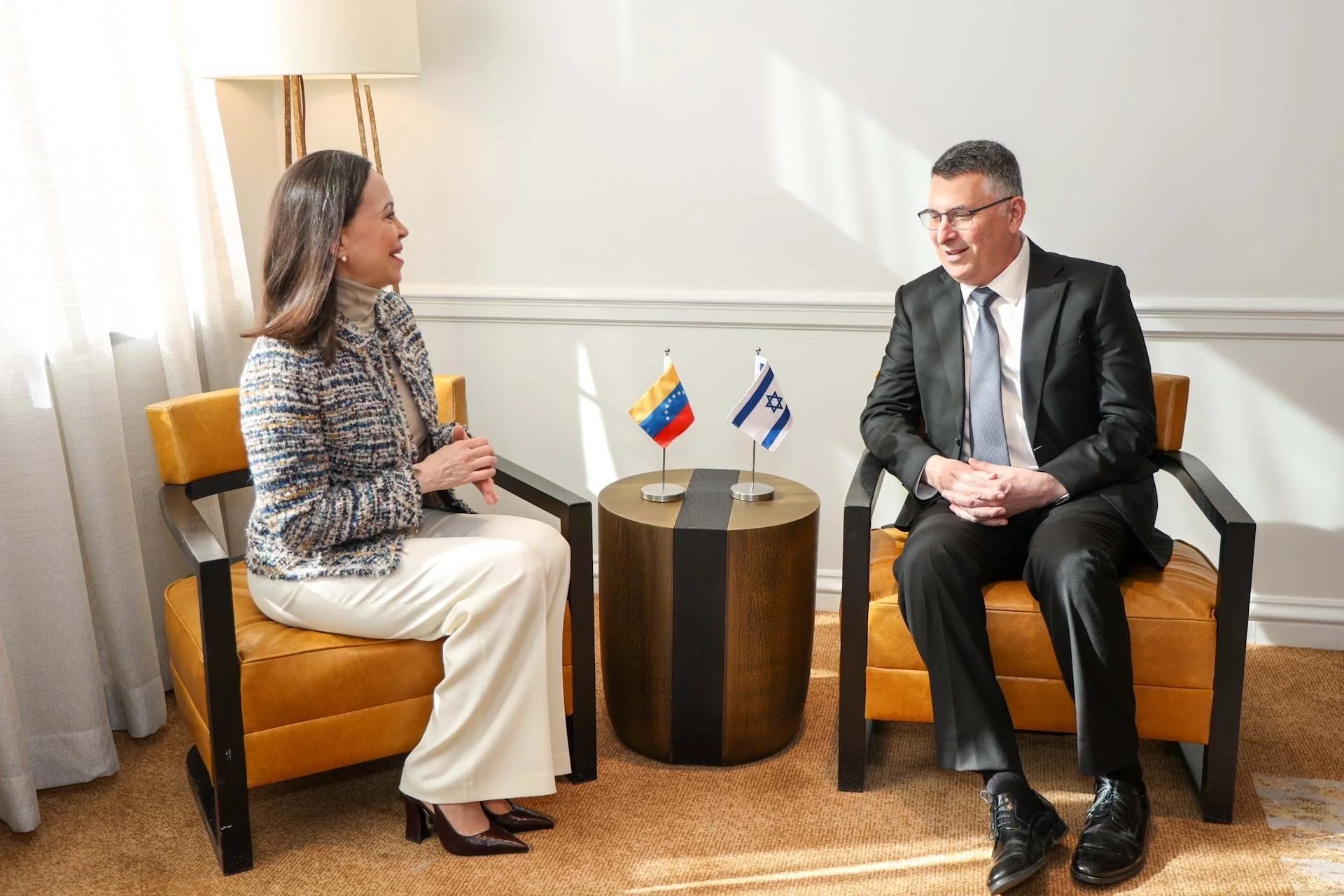
Venezuelan opposition leader María Corina Machado meets with Israeli Foreign Minister Gideon Sa’ar in Washington days before the first shipment of Venezuelan crude in 17 years departs for Israel, February 2026.
Sa'ar praised "Operation Absolute Resolve," the U.S. military’s name for the January attack on Venezuela.
Machado, whose Vente Venezuela party signed a formal cooperation agreement with Netanyahu's Likud in 2020, told Sa'ar that Venezuela and Israel share "historically close ties" she intends to "reclaim and strengthen."
Taken together, the meeting, the shipment, and the cooperation agreement make clear how operations like this happen—and why.
Operation Absolute Resolve
At 2:00 a.m. local time on Jan. 3, 2026, the first explosions ripped through Caracas. Around 150 U.S. aircraft launched from 20 airbases across the Western Hemisphere.
American forces struck Venezuelan air defenses, disabled military infrastructure, and turned off large portions of the capital's electrical grid.
President Trump later acknowledged the blackout, saying it was "due to a certain expertise that we have" without elaborating.
Special forces then descended on Maduro's compound, seized him and his wife, Cilia Flores, and extracted them by helicopter.
Venezuela's Defense Ministry later reported that 83 people were killed in the operation, including 47 Venezuelan soldiers — nine of them women — and 32 Cuban soldiers assigned to Maduro's security detail. More than 112 people were injured.
Interior Minister Diosdado Cabello said experts needed DNA testing to identify some victims, as several had been blown to "little pieces." The full extent of civilian casualties has yet to be determined.
Two days later, Maduro appeared in a Manhattan federal courtroom in handcuffs. He pleaded not guilty. "I was kidnapped," he told the judge. "I am innocent and a decent man, the president of my country."
The international response was swift and, outside the United States, largely disapproving.
UN Secretary-General António Guterres expressed concern that Washington's operation violated international law.
Ben Saul, a UN special rapporteur and professor of international law, condemned what he called "the U.S.'s illegal aggression against Venezuela and the illegal abduction of its leader."
Policy experts and law scholars — from Chatham House, from NYU, from Columbia — described the operation as a violation of the UN Charter and the foundational principle that states cannot use military force to enforce their legal claims on another country's territory.
The Trump administration framed the operation as a law enforcement action, citing Maduro's indictment on drug trafficking charges and arguing that the president possessed "inherent constitutional authority" to order the raid on the sovereign nation.
International legal experts have largely rejected that framing, noting that U.S. criminal indictments do not authorize military assaults on sovereign nations, and that Maduro retained head-of-state immunity under international law regardless of Washington's position on his electoral legitimacy.
The Chatham House analysis put the implications plainly:
"This episode further erodes international confidence in the principle, agreed after the horrors of the 20th century's world wars, that states must not enforce their legal claims or political demands through the use of force."
Taking the oil
Within days of the invasion, the Trump administration moved to take control of Venezuela’s primary source of revenue.
For context, Venezuela holds an estimated 303 billion barrels of proven oil reserves, the largest in the world—roughly 17 percent of the global total.
Under Maduro, like Chávez before him, those reserves were managed by the state oil company, Petróleos de Venezuela (PDVSA), and exported primarily to China and, for decades before sanctions, to U.S. refineries.
After the abduction, Washington moved quickly to commandeer that revenue stream.
On Jan. 9, Trump issued Executive Order 14373, which established an ostensibly legal framework for placing Venezuelan oil revenue under U.S. supervision and shielding proceeds from creditors seeking to collect on the country’s estimated $170 billion in external debt.
As for the profits from the 50 Million Barrels of Oil he announced Venezuela would hand over, Trump indicated that money “that will be controlled by me.”
The first post-invasion sale—brokered by the administration through Swiss- and Singapore-based traders Vitol and Trafigura—generated roughly $500 million, which was deposited into a U.S.-controlled account at Qatar National Bank.
None of this is being managed by neutral technocrats. Vitol and Trafigura are not humanitarian outfits; both have paid large penalties in recent years for bribery and market manipulation in oil and commodities markets.
Senate Democrats have since demanded to know whether senior White House officials hold personal stakes in those trading houses or in such stocks such as Chevron, ExxonMobil, and ConocoPhillips, whose executives were among 17 oil majors summoned to the White House. as Trump announced that the United States would “take over” Venezuelan oil sales.
The parallel effort to auction off Citgo to an affiliate of Elliott Management—run by Republican megadonor Paul Singer—only deepens the sense that this is less an anti-corruption crusade than a distressed-asset opportunity for a familiar circle of firms.
Chevron occupies a special place in that picture. It was the only U.S. major allowed to keep operating in Venezuela under the old sanctions regime, and now stands near the front of the line for new drilling blocks and long-term contracts in an oil sector reshaped by a war its own industry spent years lobbying around.
Secretary of State Marco Rubio confirmed the Qatar arrangement during testimony before the Senate Foreign Relations Committee. He explained that Venezuelan authorities must now submit a monthly budget to Washington for approval before receiving disbursements.
“Venezuela will submit every month a budget of ‘this is what we need funded,’” Rubio told lawmakers. “We will provide for them at the front end what that money can be used for.”
By mid-February, Energy Secretary Chris Wright announced during a visit to Caracas—the highest-level U.S. energy visit in decades—that oil sales under U.S. management had surpassed $1 billion, with an additional $5 billion in short-term agreements lined up.
Revenue, he said, would now flow through a newly established U.S. Treasury account rather than the Qatar intermediary.
The Treasury Department also issued a general license for Venezuelan oil production that explicitly barred Russia and China from participating, while easing conditions for certain U.S. and European companies.
Democrats in Congress have demanded transparency.
Senator Adam Schiff introduced legislation directing the Government Accountability Office to audit the Qatar account and the broader revenue scheme.
Others have questioned Senator Rubio and Treasury Secretary Scott Bessent about why the administration chose Qatar—a jurisdiction that recently furnished Trump with a $400 million private jet—over countries with stronger financial-oversight traditions, such as Norway.
The administration has not publicly responded.
Legal analysts have noted uncomfortable structural parallels between the Venezuelan oil-revenue arrangement and the Development Fund for Iraq, the U.S.-administered account that has managed Iraqi oil proceeds since the 2003 invasion.
In both cases, a foreign state’s primary export earnings are captured in accounts controlled or supervised by Washington, with spending decisions subject to outside approval.
If Iraq’s experience is any indication, what begins as a “temporary” custodial measure can harden into open-ended control, with little recourse for the people whose resources are being managed.
Trump, for his part, has been explicit about his intentions. He has said he plans to “run” Venezuela indefinitely and distribute oil revenue “as he sees fit.”
At that same White House session with the executives of the 17 oil companies, Trump boasted that investment in Venezuela would reach “at least $100 billion.”
During his remarks on the topic, Trump invoked the Monroe Doctrine by name — the 19th-century declaration of U.S. supremacy over the Western Hemisphere — claiming to have "superseded it by a lot" with what he dubbed the "Donroe Document."
The administration insists it is not engaged in nation-building. Simultaneously, by its own president's account, it’s also running a foreign country, controlling its primary revenue stream, designating its leadership, and invoicing it for the cost of the invasion — all under a doctrine of hemispheric dominance that Trump named after himself.
At one point,17 oil companies were called to the White House to discuss investments, with Trump promising execs that the total would reach "at least $100 billion."
Creditors are made to wait, while preferred corporations are invited in.
All of this is marketed as democracy promotion and counter-narcotics policy, yet it functions like a foreclosure sale reinforced by an air force.
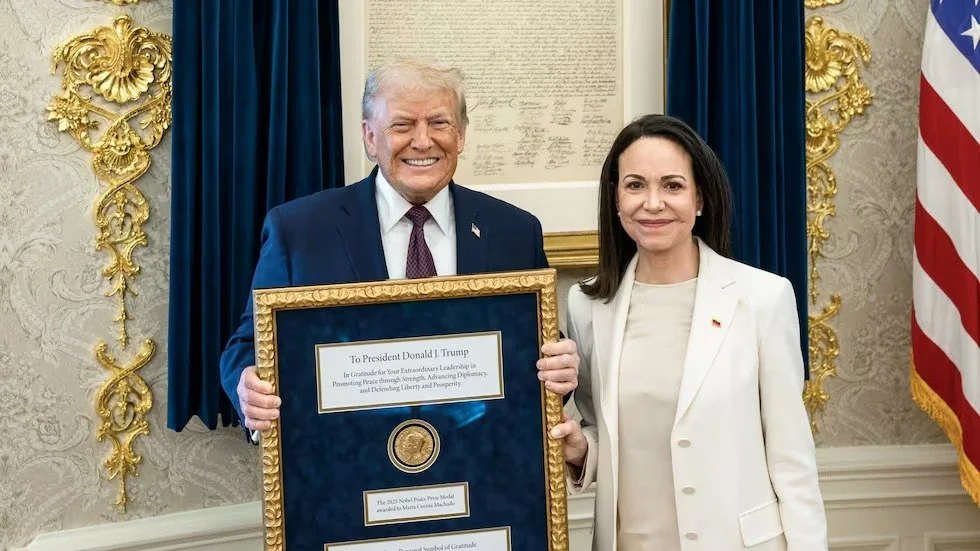
Venezuelan opposition leader María Corina Machado presents her 2025 Nobel Peace Prize to U.S. President Donald Trump during a White House visit on Jan. 16, 2026, after publicly crediting him for her award and backing his intervention in Venezuela.
The designated successor
If Washington views Maduro as an obstacle removed, María Corina Machado is seen as the (re)alignment Washington prefers.
After Machado won the 2025 Nobel Peace Prize for her opposition to the Maduro government—a prized Trump coveted like a stoor hobbit corrupted by greed— she she traveled to the White House and personally presented Trump with the medal
Notably, this is a gesture the Nobel Institute had already said is impermissible — the prize cannot be transferred or shared.
Her political alignment extends well beyond Washington. In October 2025, days after her Nobel announcement, Machado spoke by phone with Israeli Prime Minister Benjamin Netanyahu.
According to statements from Netanyahu's office, she praised Israel's military operations in Gaza, as well as its campaign against Iran, describing Israel as a partner against threats affecting both nations.
Machado had previously pledged to move Venezuela's embassy from Tel Aviv to Jerusalem and to reestablish diplomatic relations with the increasingly isolated religio-ethno state.
Those pledges are grounded in formal institutional ties. In 2020, Machado's Vente Venezuela party signed a cooperation agreement with Netanyahu's Likud covering "political, ideological, and social issues, as well as those related to strategy, geopolitics, and security."
In 2018, she had written directly to Netanyahu and then-Argentine President Mauricio Macri requesting international military support for regime change in Venezuela.
During Machado’s meeting Sa'ar in Washington, Sa'ar publicly referred to the bombing of Caracas and abduction of Maduro as "historic."
Machado again spoke of reclaiming ties in "this new era of democracy and freedom."
Days later, like magic, Venezuelan crude was on its way to an Israeli refinery.
The pipeline from invasion to oil shipment could not be more direct.
A sovereign nation's leader opposed commercial and diplomatic ties with Israel. The United States removed that leader by military force.
His designated replacement has longstanding ties to Israel. The oil now flows to a country engaged in a military campaign that the International Criminal Court has characterized as involving war crimes, and whose prime minister faces an active ICC arrest warrant.
For many Venezuelans — indeed for observers across Latin America — the Machado-Israel connection does not signal a "democratic reset." Instead, there is concern that Venezuela will become the U.S.’ means of continuing to fuel Israel’s genocide.
There are rising concerns that a post-Maduro Venezuela will be integrated into the U.S.-Israel security architecture on terms set by Washington and Tel Aviv, with Venezuelan sovereignty and resources serving as the currency of entry.
Boats burning in international waters
The January invasion was only the lates aggression against Venezuela, preceded by months of escalation which, viewed in sequence, reveal a deliberate campaign to create the conditions for military action.
Beginning in September 2025, U.S. forces carried out more than two dozen drone strikes against small boats in the Caribbean and eastern Pacific, killing more than 100 people.
The administration framed the operations as a war on "narcoterrorism," treating alleged drug traffickers as terrorist combatants rather than criminal suspects.
Senior officials, including Defense Secretary Pete Hegseth, posted footage of the strikes — boats exploding, fire streaking across open water — to official social media accounts.
The legal theory rested on the Trump administration's designation of certain Latin American cartels as foreign terrorist organizations and the assertion that the United States was engaged in a "non-international armed conflict" with those groups.
That designation, in turn, provided the justification for killing suspects at sea without attempting to board, arrest, or otherwise apply the criminal justice process that international law requires.
UN special rapporteurs have repeatedly condemned the strikes.
In November 2025, the office of UN High Commissioner for Human Rights Volker Türk warned that the pattern of boat strikes violated international human rights law and risked amounting to a campaign of extrajudicial killings.
Human Rights Watch reached the same conclusion, describing the operations as executions carried out without due process.
On a plain reading of the UN Convention on the Law of the Sea, repeated missile strikes on foreign boats in international waters — without boarding, warning, or any attempt to rescue — are at odds with its principles of flag-state jurisdiction, freedom of navigation, and the duty to assist people in distress at sea.
In at least one strike reviewed by UN investigators, U.S. forces returned roughly an hour after the initial blast and fired again on survivors clinging to debris, killing all of them.
The incident drew intense scrutiny because it undercut any claim of immediate threat or tactical necessity, suggesting instead a deliberate policy of ensuring no survivors.
The administration's initial response was to publicly take credit for the strike, with the White House twitter posting video of the incident.
After the reality of the double tap became scrutinized, they rushed to narrow political ownership: with Hegseth emphasizing the strike order had come from the commanding admiral, Frank “Mitch” Bradley.
Next, once the blame was officially assigned, Hegseth went back to endorsing the decision—defiantly so—while never quite dispelling reports that it was him, in fact, who given the order.
Families in the region say some of the dead were fishermen or informal couriers who never received a warning, let alone a chance to surrender.
The International Drug Policy Consortium and other advocacy networks have documented dozens of deaths and accused Washington of using "narcoterrorism" rhetoric to strip people of basic legal protections once they push off the beach.
At the policy level, the boat strikes served a dual purpose. They reinforced the administration's narrative that Venezuela was a "narcoterrorist" state, justifying escalation.
They established U.S. military dominance in the waters surrounding Venezuela. They habituated the American public to images of lethal force in the region. By the time the January operation launched, the Caribbean had already been converted into a theater of war.
Maritime blockade and tanker seizures
Parallel to the boat strikes, the administration launched a campaign of tanker seizures that amounted to a de facto naval blockade of Venezuelan oil exports.
In December 2025, U.S. forces seized the supertanker Skipper off Venezuela’s coast, one of the world’s largest crude carriers, claiming it was transporting sanctioned Venezuelan and Iranian crude for a shadow fleet linked to Iran’s Revolutionary Guard and Hezbollah.
Within days, the US Coast Guard intercepted the tanker Centuries, carrying nearly 2 million barrels of Venezuelan crude bound for China, and initiated pursuit of a third vessel, the Bella 1, under a judicial seizure order.
Trump publicly vowed to enforce a "total and complete blockade" on sanctioned tankers entering or leaving Venezuela.
Officials later softened the language to "quarantine" in public talking points, though the operational effect was the same: tanker captains began making U-turns, vessels sat idle offshore, and insurers raised rates to levels that effectively priced out independent operators.
The seizures came at a particularly vulnerable moment. Just days earlier, a cyberattack struck PDVSA's central administrative systems, forcing the suspension of exports and disrupting the systems that move oil to market.
Venezuelan officials accused the United States of responsibility, a charge Washington did not confirm in initial reporting and has still not publicly acknowledged.
That continued silence sits awkwardly beside Trump’s own October, 2025 admission that he had authorized the CIA to conduct covert operations in Venezuela, supposedly to confront drugs and migration.
Notably, defense analysts and cybersecurity experts have indicated that the operation bore hallmarks of state-level sophistication far beyond the capacity of criminal hackers.
Notably, defense analysts and cybersecurity experts have indicated that the operation bore hallmarks of state-level sophistication far beyond the capacity of criminal hackers.
By the end of December, U.S. naval vessels, warships, and fighter jets had established a permanent military presence off Venezuela's coast, accompanied by the covert operations.
The combination of tanker seizures, drone strikes, cyber disruption, and military buildup created the conditions under which the January invasion could be sold as the next logical step rather than an unprecedented act of aggression.
Citgo pipeline and the debt trap
While ships idled and oil revenue was redirected to Qatar, the long-running legal battle over Citgo — Venezuela's most valuable overseas asset — reached its conclusion.
In late November 2025, a Delaware federal judge authorized the sale of shares in PDV Holding, the parent company of Citgo Petroleum, to Amber Energy, an affiliate of Elliott Investment Management.
Amber won a court-mandated auction with a bid of approximately $5.9 billion.
The case originated years earlier, when Canadian mining company Crystallex used a U.S. court ruling to hold PDVSA liable for unpaid debts.
Other creditors joined, and the dispute expanded into a sweeping effort to seize Venezuelan state assets held under U.S. jurisdiction.
That effort ultimately centered on Citgo, which operates three major refineries and thousands of branded gas stations across the United States.
The sanctions regime made this outcome close to inevitable. Financial restrictions cut PDVSA off from dollar financing and most U.S. refiners, contributing to default.
Once Venezuela could no longer service its debts, bondholders and arbitration claimants turned to Citgo as their primary target — while the same sanctions simultaneously limited Venezuela's ability to retain counsel, raise capital, or negotiate from a position of strength.
Put plainly: sanctions created the default, and the default created the conditions for asset seizure.
Analysts critical of the arrangement have called it a de facto confiscation of a strategic state asset.
The irony is now compounded by Trump's own executive order shielding new oil revenue from the very creditor class that the sanctions regime empowered to claim Citgo in the first place.
The administration, in effect, built one legal architecture to strip Venezuela of its refinery network and another to protect the revenue stream it seized after the invasion.
That dynamic reflects a broader pattern visible across the developing world.
The United Nations and World Bank have documented that more than 3 billion people live in countries that now spend more on debt service than on health or education.
Governments throughout the global South borrowed in dollars to build infrastructure in economies already weakened by colonial extraction and commodity dependence.
As pandemics, rate hikes, and climate disasters strained those economies, distressed bonds migrated into the hands of funds that litigate for full value in Western courts.
Venezuela's experience is an extreme case, but the underlying machinery — private creditors, legal forums, and national assets as collateral — is standard issue.
Cuba as collateral damage
The consequences of the U.S. campaign against Venezuela extend beyond its borders, most immediately to Cuba.
Cuban energy infrastructure has long depended on Venezuelan oil shipments, often provided on concessionary terms. As sanctions tightened and PDVSA's output declined, those supplies shrank.
The result has been rolling blackouts across Cuba, including extended outages in Havana, worsening an economic crisis that already drives shortages of food and medicine.
“Cuba will be failing pretty soon. Cuba is really a nation that's very close to failing.”
-Donald Trump, Jan. 27, 2026
The January invasion deepened the damage in ways both symbolic and material. Thirty-two Cuban soldiers were among those killed in the Caracas raid, a fact that drew a sharp response from Havana.
Cuban President Miguel Díaz-Canel shook hands with protesters before giving a speech in which he accused Washington of opening "the door to an era of barbarism, plunder, and neo-fascism."
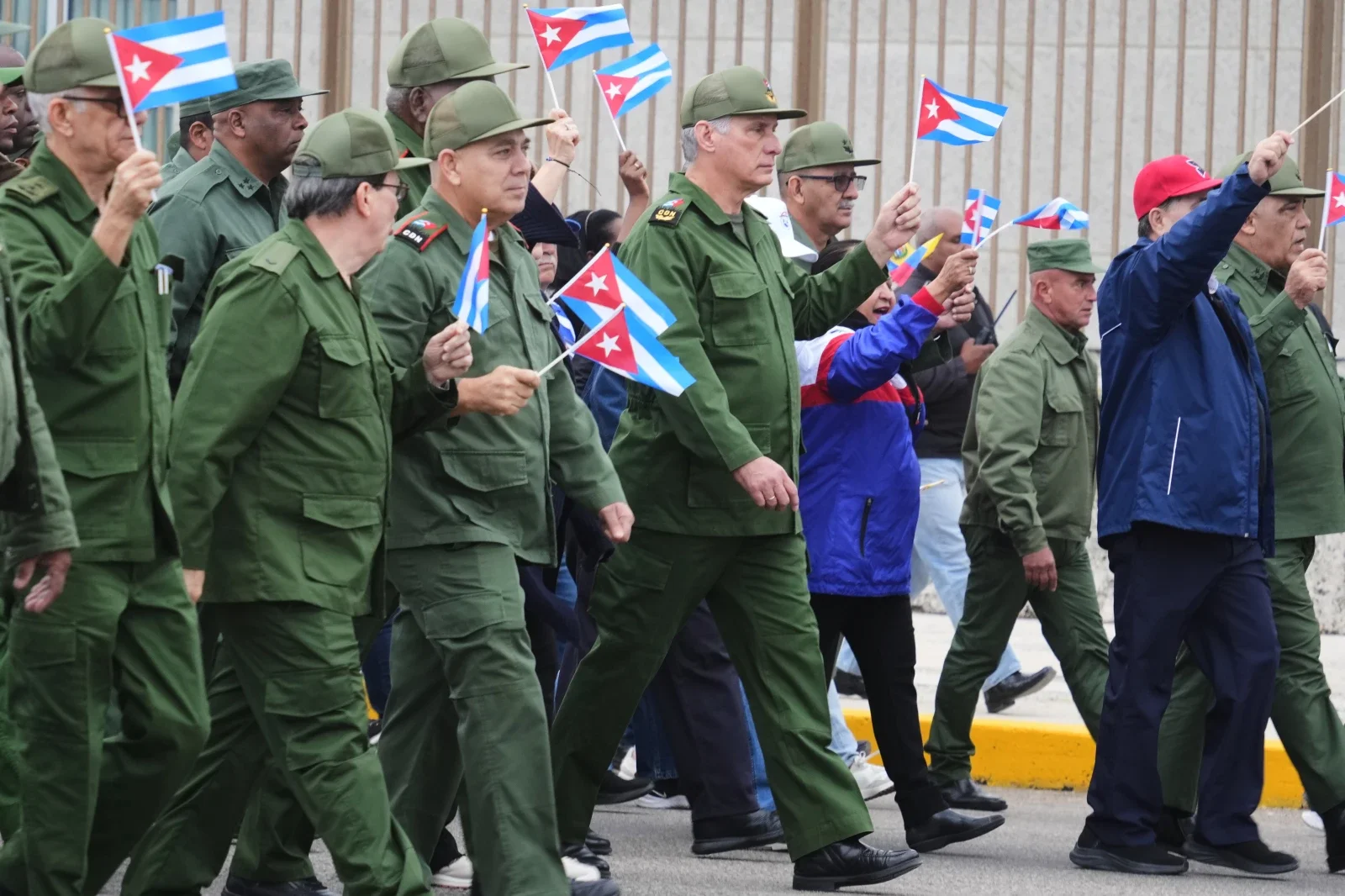
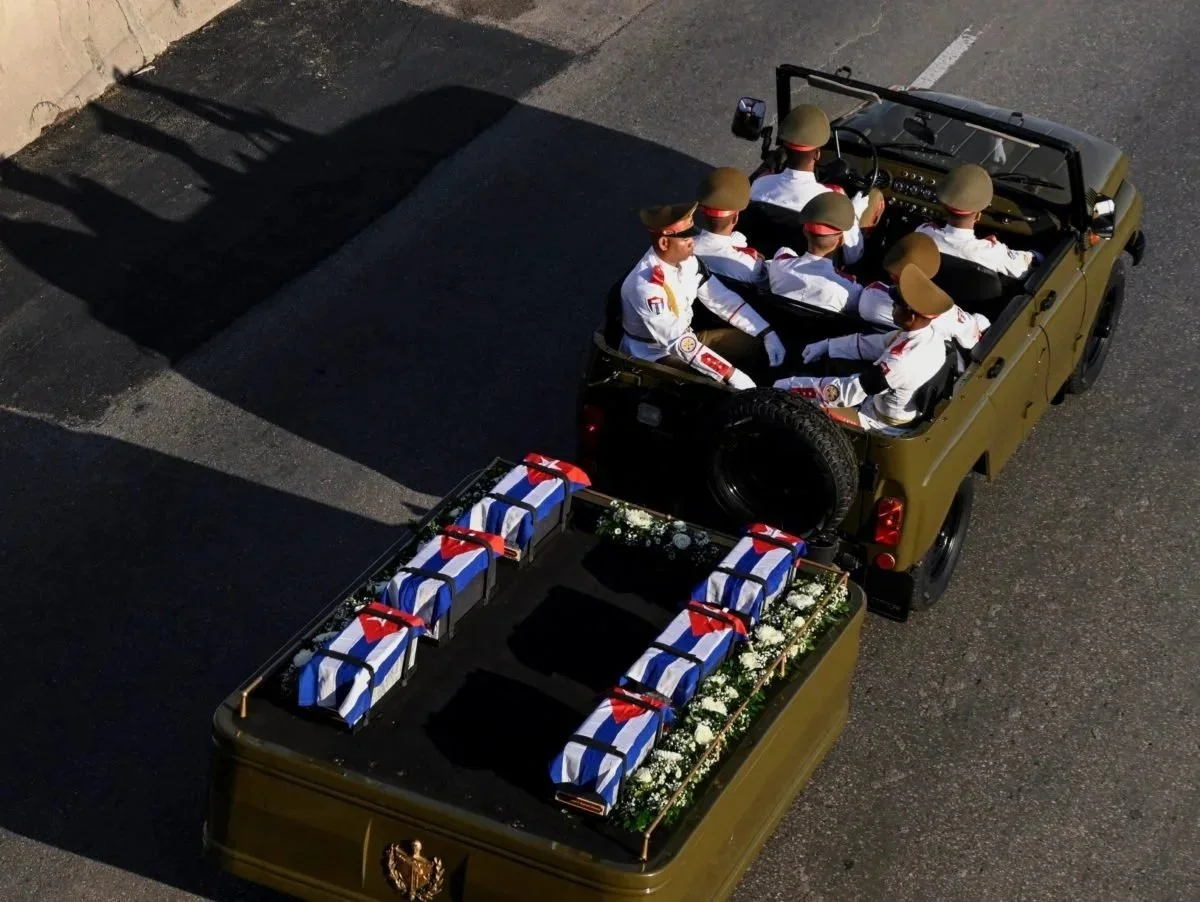
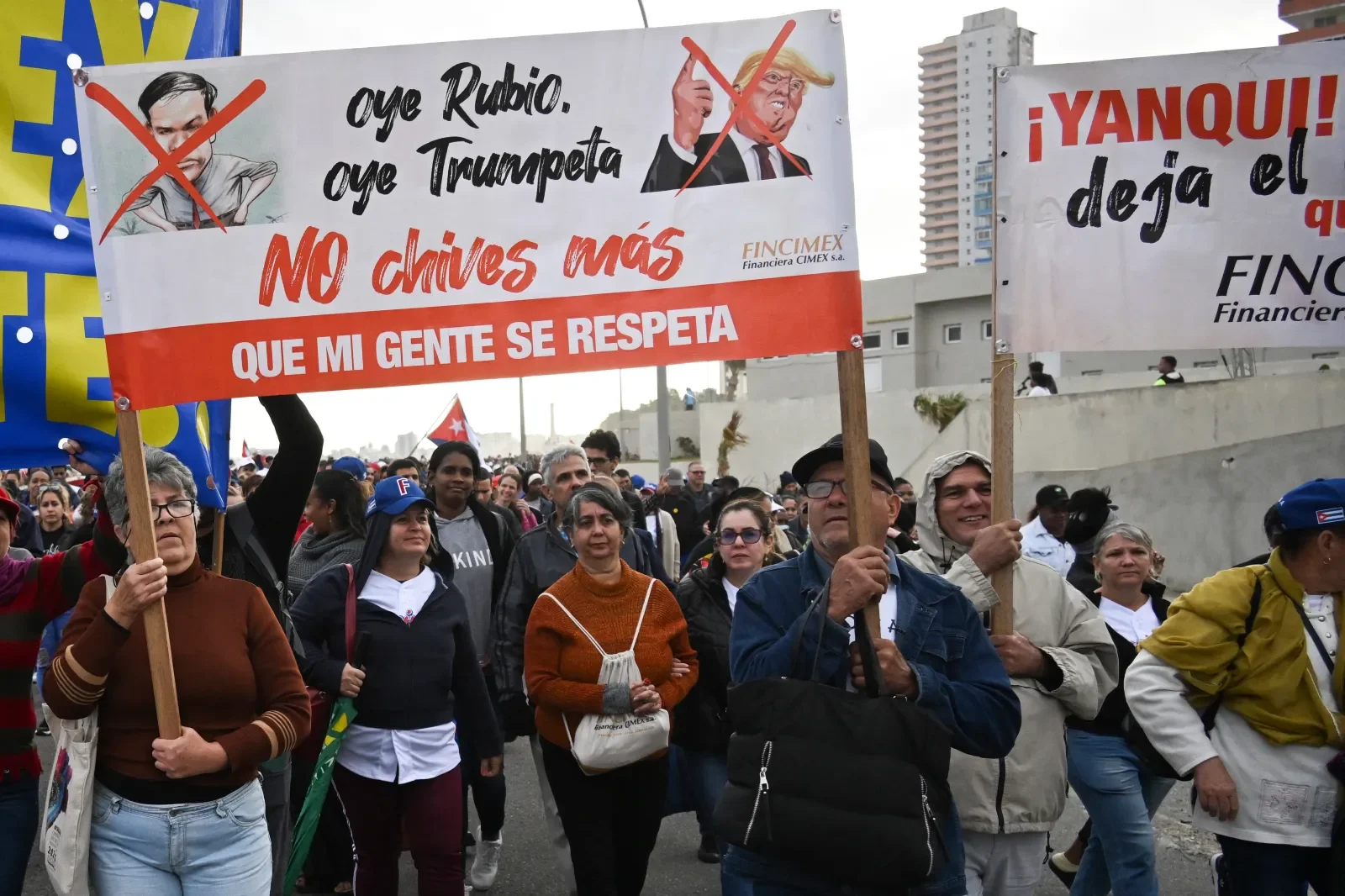
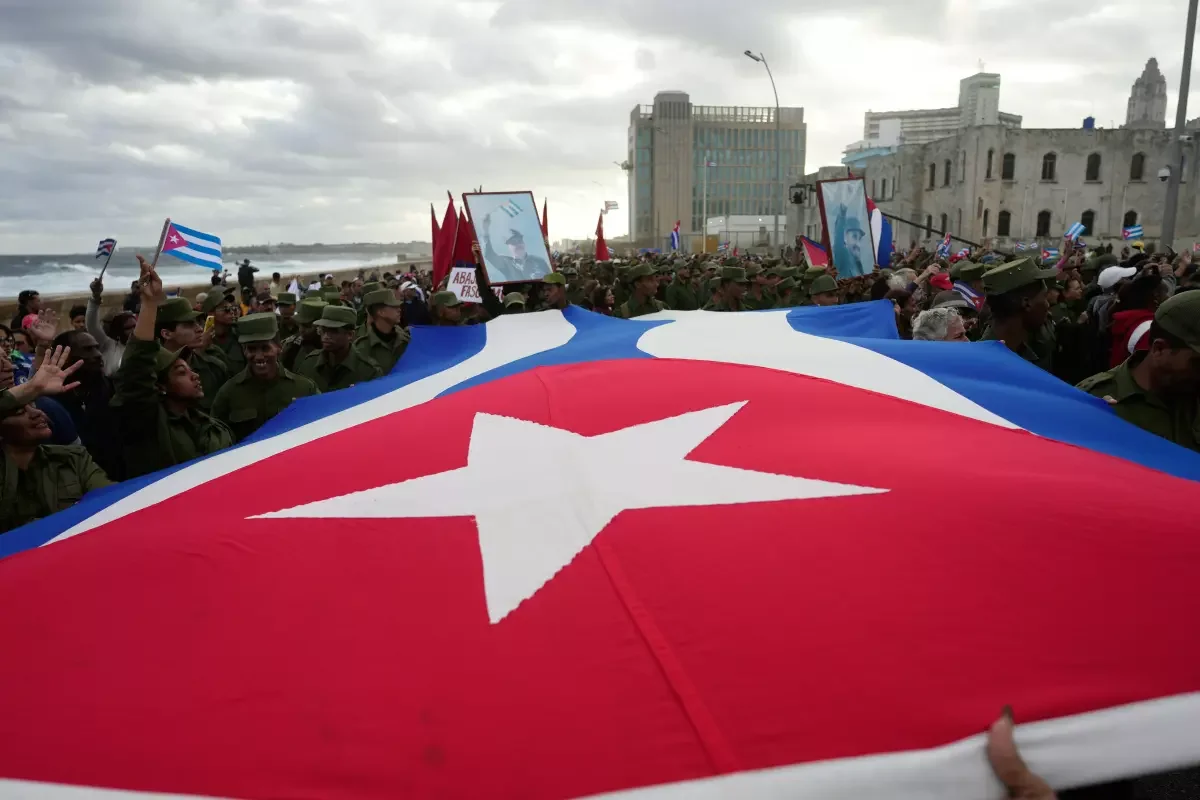
Each tanker seized or blockaded represents fuel that will not reach Cuban ports. When the administration intercepted Venezuelan-bound vessels, Cuban officials denounced the operations as "piracy and maritime terrorism" that punishes ordinary citizens who never voted to jeopardize their energy supply.
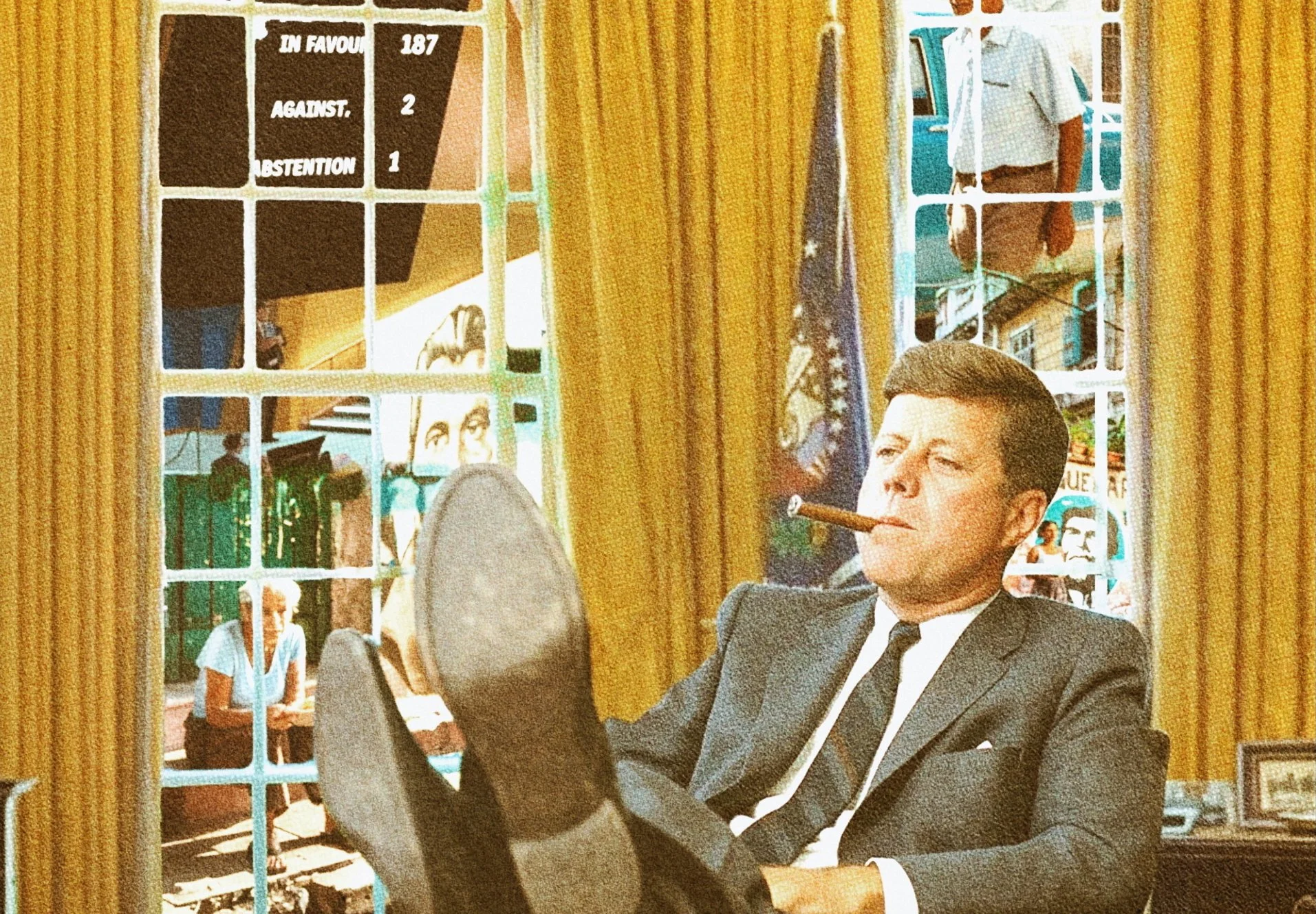
There is a direct historical antecedent. In the early 1960s, U.S.-aligned oil companies — Texaco, Esso, and Shell — declined to process Soviet crude arriving in Cuba, likely with U.S. encouragement.
When Cuba nationalized the refineries, President Eisenhower retaliated by slashing Cuba's sugar quota and later imposed the trade embargo that persists six decades later.
Little has changed since. Whereas Washington used control over refineries and sugar markets as leverage in 1960, it now uses shipping lanes, tanker insurance, cyber operations, and military force to similar effect.
Cuba sits downstream of that strategy in both geography and time.
The long shadow of Chile, Guatemala, and Condor
When Latin American audiences look at what the United States has done to Venezuela, they see a pattern they have lived through before.
In Guatemala in 1954, the Eisenhower administration and the United Fruit Company framed President Jacobo Árbenz's modest land reform as a Soviet threat.
Declassified CIA histories of Operation PBSUCCESS describe a campaign of psychological warfare, diplomatic pressure, and corporate lobbying that paved the way for a coup, a military dictatorship, and decades of repression.
In Chile in the early 1970s, declassified records show that President Richard Nixon ordered the CIA to prevent Salvador Allende from taking office or to remove him once in power.
In a September 1970 meeting, Nixon told aides to "make the economy scream."
The United States cut off credit, encouraged strikes, and backed covert operations that helped set the stage for the 1973 coup and the Pinochet dictatorship.
That logic hardened into Operation Condor, as Southern Cone dictatorships — Argentina, Chile, Uruguay, Paraguay, Bolivia, and Brazil — coordinated intelligence sharing, disappearances, and cross-border assassinations under the banner of defending "democracy" from left-wing subversion, often with tacit U.S. support.
Venezuela lives inside that continuum. Little changes there, though the tools have undeniably been updated. Now they include targeted sanctions, cyber operations, and propagandizing drone footage of burning boats and military raids filmed for social media.
The underlying logic remains the same: when a government adopts policies that clash with U.S. preferences on oil, debt, or regional alignment, the full spectrum of economic, legal, and military pressure comes into play.
To be sure, allegations of repression against the Maduro government are real, and they are documented. They are also invoked selectively.
UN bodies and human rights groups have issued similarly grave findings against the United States, from mass incarceration and police violence at home to extrajudicial killings and indefinite detention abroad.
The distinction is not the presence of abuse; it is the distribution of power. One set of allegations triggers sanctions, asset seizures, and regime change. The other is absorbed, managed, and exempted from consequence.

Who writes the contracts
Venezuelan crude, extracted from the largest proven reserves on Earth, is now administered by a foreign government that bombed a capital city to seize them.
That oil is being sold through channels that bar the nation's largest trading partners, with revenue deposited in accounts subject to American approval and disbursed according to budgets Washington reviews each month.
The designated political successor has formal ties to a foreign ruling party whose prime minister faces an ICC arrest warrant.
She has pledged to move her country's embassy to a contested capital in violation of international consensus.
During her visit to Washington, she regifted her Nobel Peace Prize to the president who, incidentally, ordered the invasion that made her ascent possible.
The oil now flows to Israel, the country Venezuela's abducted leader refused to do business with for 17 years.
The first shipment moved within weeks of Machado’s meeting with Gideon Sa'ar in Washington.
Venezuelan Information Minister Miguel Pérez Pirela called the report "FAKE!" on social media. Bloomberg's sources said the deal was never intended to be made public.
The histories of Chile, Guatemala, Cuba, and Condor tell us what these patterns produce: long cycles of extraction, instability, and loss borne by the people who live inside the machinery, never by those who design it.
"Venezuela sanctions" once served as shorthand for this crisis. That term no longer captures what is happening.
The United States has conducted an act of military aggression against a sovereign nation, abducted its president, killed its soldiers and civilians, seized control of its primary revenue source, and begun redirecting that revenue to allies and preferred buyers — all while claiming it was a law enforcement operation.
From the television screen, the footage looks clean, clinical even. A small boat, hit by a drone strike, disintegrates. An hour later, a second strike comes back to finish off the survivors. Thirty-six more strikes follow.
A tanker changes course. Another is seen besieged by special forces rappelling from Blackhawk helicopters; then another, and another.
An American president’s social media account boasts an image of a blindfolded, bound head of state, taken from his home and nation by thieves in the night.
A shipment of barrels is loaded onto tanker bound for a port that was closed to it for nearly two decades in protest of Israel’s genocide against Palestinians.
Despite the prattling of various talking heads, the president of Venezuela isn’t in an American prison because he was an authoritarian. Authoritarian allies are easy to accommodate; Washington has a running list.
Hell, in 2026, Washington is an authoritarian entity in its own right.
Maduro was removed because he was the wrong kind of authoritarian — the kind who sat on 303 billion barrels of oil and refused to hand over the keys to encroaching imperialists.